
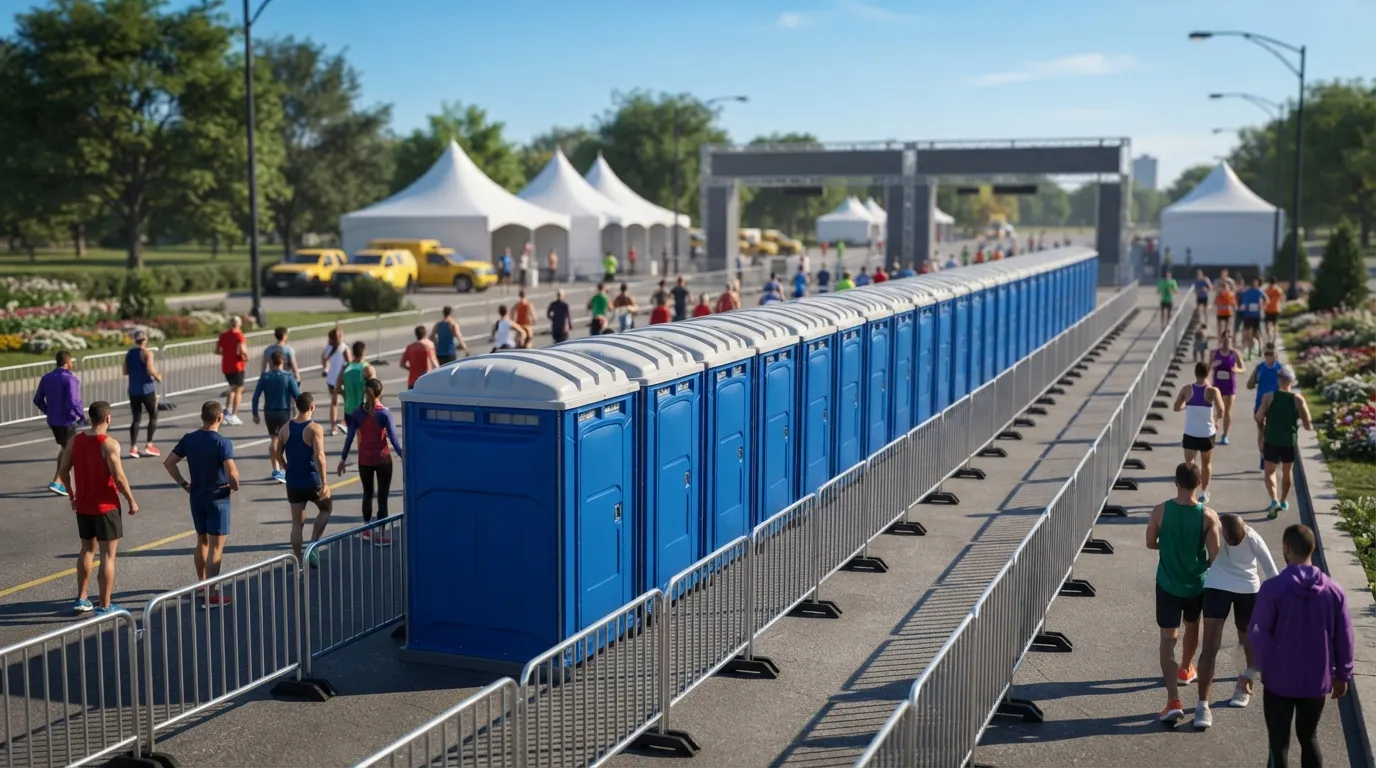
How many restrooms does a race in Warren need?
Runner count drives the math, but so does course length and how spread out your aid stations sit. A 5K with 500 runners looks nothing like a half marathon with three water stops and a two-hour finish window. Warren Porta Pros starts with how many porta potties do I need as a baseline, then adjusts for spectators, volunteers, and staff at the timing tent. OSHA 1926.51(c) sets ratios for job sites, not races, but it is still the closest published benchmark: one toilet for every 20 people, scaling up from there. For a race, that number moves fast once you add family members waiting at the finish. A typical setup pairs standard porta potty rental units at each mile cluster with at least one ADA accessible porta potty per bank of units, matching the 5 percent minimum in ADA Standards 213.2. Larger races in Warren often add a restroom trailer rental at the finish line for sponsors, timing staff, and VIP tents. A 2 stall restroom trailer handles a smaller finish area; an 8 stall restroom trailer fits a festival-scale finish with a beer garden and awards stage. Course marshals and generator operators also need power. If your timing tent runs on a temporary power pole, brace it with guy wires staked at a wide angle and keep the base plate on stable, level ground, since a loaded pole under load at a busy intersection is not something you want tipping mid-race. Knowing how to brace a temporary power pole matters here: set the base plate on stable, level ground, run guy wires out at a wide angle in at least three directions, and stake each anchor well clear of the runner lane so nobody catches a line at a sprint.
What does marathon restroom rental cost in Warren?
Pricing depends on unit count, event length, and whether you need trailers at the finish. A one-day standard unit runs in the same range covered on porta potty rental cost, and most race organizers rent for the weekend rather than a single day, since setup usually happens the afternoon before.
| Unit | Day | Week | Weekend (prose) |
|---|---|---|---|
| Standard | $100 - $350 | $130 - $500 | $125 - $400 |
| ADA unit | $200 - $400 | $185 - $240 | $199 - $300 |
| Restroom trailer | $175 - $2,500 | $1,397 - $1,650 | $900 - $3,000 |
Delivery adds a separate fee, and most races in Warren book delivery a day ahead so units are staged before packet pickup. See porta potty rental per day for single-day math if your event is a short fun run rather than a full course closure. Races that book Warren Porta Pros for multiple weekends across a season sometimes do better on monthly porta potty rental terms if the same units stay parked at a training facility between events. For a full weekend build with trailers, generators, and a fencing perimeter, get a request a quote built around your actual course map rather than a flat per-unit price.
Where should restrooms go along the race route?
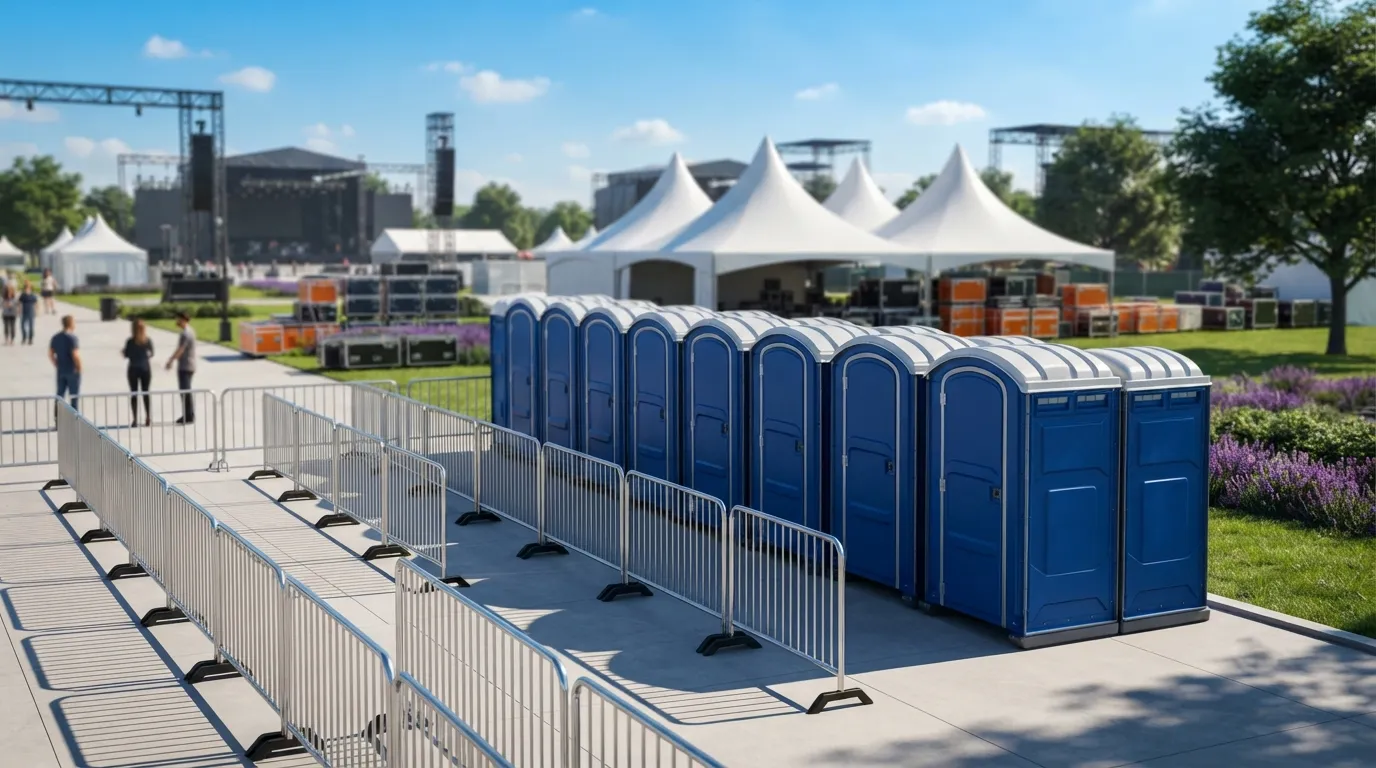
Placement matters more on a race course than almost anywhere else, because runners cannot detour far without losing time. Units belong just off the running lane, on a firm, level pad, never on the crown of the road where a stumble sends someone into traffic. ADA Standards 302.1 calls for stable, slip-resistant ground, which matters even more when race-day weather turns a grass shoulder to mud. Keep a 36 inch clear path to each ADA unit per ADA Standards 403.5.1, and make sure the door swings clear at the 32 inch minimum in ADA Standards 404.2.3. Our porta potty placement guide covers ground conditions in more depth. If your course crosses through a construction zone or a section with active roadwork, treat that stretch like a job site and follow OSHA portable toilet requirements for any crew still working nearby. Races with a beer garden, sponsor row, or fenced VIP area at the finish usually add temporary fence rental or crowd control barrier rental to route foot traffic past restrooms without bottlenecking the finish chute. Warren races that run through Madison Heights, 5.7 miles west, or share timing crews with Roseville events 6.1 miles east, often stage a second restroom bank at a satellite parking lot for shuttle buses. If your race needs handwashing near a food tent, add a handwashing station rental rather than relying on sanitizer alone, since 29 CFR 1910.141(d)(2) specifies soap and towels or a hand-drying device, not gel.
How far in advance should we book restrooms for a race?
Book four to six weeks out for a race over 500 runners, sooner if you need a restroom trailer. Trailers and ADA units book up first during spring and fall race season in Warren. A request a quote call early locks your unit count before another event on the same weekend takes the inventory.
Do we need an ADA unit even for a small 5K?
Yes. ADA Standards 213.2 requires at least one accessible unit anywhere portable toilets are clustered, regardless of race size. A single ADA unit alongside your standard bank satisfies it for most small races.
Can restrooms be moved mid-race for a course change?
Units can be repositioned before or after race day, but not safely during active running. Plan your final layout at the course walk-through and treat the map as fixed once bibs go out.
What about restrooms for volunteers at water stations?
Water stations often get skipped in restroom planning, but volunteers stand there for hours. A single standard unit at each major aid station, positioned off the runner lane, covers volunteer needs without adding runner-facing units.
Do we need power for a finish-line restroom trailer?
Restroom trailers with flushing fixtures and lighting need a power connection, usually from a generator or a temporary power pole. Confirm amperage with Warren Porta Pros before the trailer arrives so cords reach without running across the runner path.
Next step
Get a delivery date
Tell us the address, the dates and the headcount. We size the order and confirm the route.