
What do we bring for a disaster response?
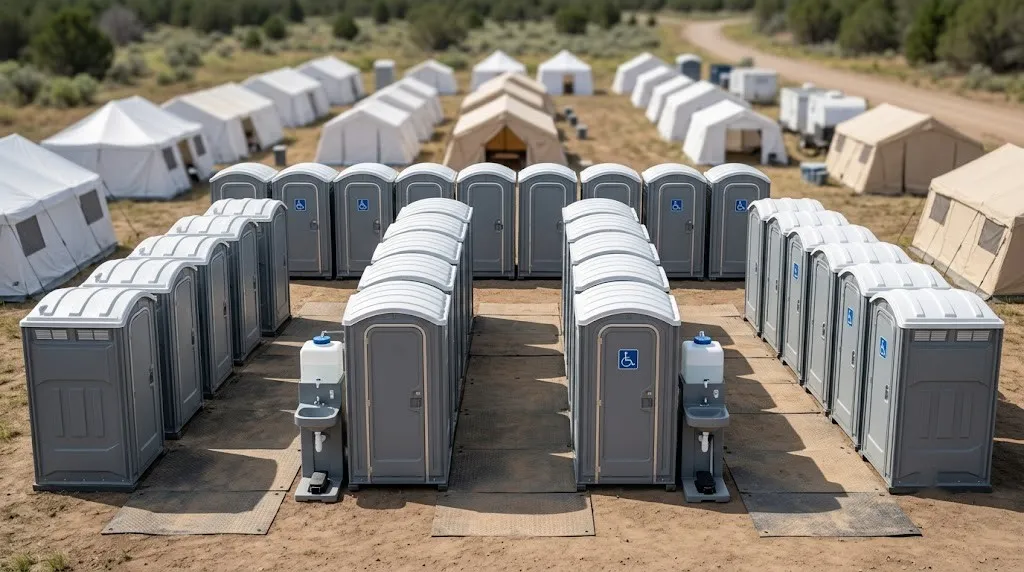
Every emergency deployment starts with standard portable toilets because they set up fast and need no water hookup, which matters when a water main is the reason you called. Each unit holds a 60 to 70 gallon tank and sits about 44 by 48 inches on the ground, so it fits driveways, parking lots and staging areas without much site prep. If the location needs to serve people with mobility limits, we add ADA accessible units built around the same standards FEMA shelters and municipal sites are expected to meet: ADA Standards 304.3.1 calls for a 60 inch turning circle, and 404.2.3 sets minimum door width at 32 inches. Where clusters of single-user toilets go in, ADA Standards 213.2 requires at least 5 percent of the units, and never fewer than one, to be accessible.
Water service outages are common in disaster response, which is why we pair toilets with handwashing stations or a portable sink rental rather than relying on hand sanitizer alone. Under 29 CFR 1910.141(d)(2), washing facilities need soap and towels or a hand-drying device; sanitizer by itself does not satisfy that. For larger shelters or command posts, an 8 stall restroom trailer or a 4 stall restroom trailer gives displaced residents and responders a private, climate-controlled option instead of standing in line outside. We also stock temporary fencing to secure debris zones and a light tower rental for after-dark staging, since OSHA 1926.56(a) sets minimum illumination levels for active work areas.
How fast can Warren Porta Pros deliver in an emergency?
Speed is the whole point of an emergency porta potty rental: we prioritize disaster calls ahead of routine bookings and dispatch from stock already staged near Warren. A roll-off delivery needs about 60 feet of straight clearance behind the truck, so we ask dispatchers or site coordinators to have that path clear before we arrive, whether that is a shelter parking lot or a staging area near a damaged neighborhood. If Warren's response overlaps with a mutual-aid request, our trucks can reach nearby communities fast too: Madison Heights sits 5.7 miles west, Roseville is 6.1 miles east, Eastpointe is 7.6 miles southeast, and Ferndale is 8.4 miles southwest, so a single dispatch run can often cover more than one affected area in a single trip.
For debris cleanup that follows flooding or storm damage, a roll-off dumpster rental usually goes out alongside the toilets, sized by what came down: a 20 yard dumpster rental handles most residential debris, while a 30 yard dumpster rental suits larger commercial cleanup. Know that what cannot go in a dumpster still applies during disaster cleanup, since hazardous debris like propane tanks or chemical containers needs separate handling regardless of the emergency. If septic systems back up from flooding, our septic pumping service and emergency septic service crews run alongside the sanitation delivery rather than as a separate call.
What does emergency sanitation cost during a disaster?
Emergency and short-duration pricing runs close to standard weekend and daily rates, since disaster response is inherently short-term work billed by the day or the event rather than by the month.
| unit | duration | typical price |
|---|---|---|
| standard toilet | day | $150 |
| standard toilet | weekend | $250 |
| ada unit | day | $230 |
| dumpster | weekend | $440 |
| delivery fee | day | $150 |
Longer deployments, such as a shelter that stays open for weeks after a major flood, shift to monthly porta potty rental pricing instead, which brings the per-day cost down considerably. Full detail on how these numbers get built lives on our porta potty rental cost and porta potty rental per day pages, and general guidance on sizing a job sits on how many porta potties do I need. OSHA 1926.51(c)(1) sets a baseline of one toilet for every 20 people, which is a reasonable starting ratio for shelter and staging-area planning even outside a construction context.
Do you need a permit for emergency portable toilets in Warren?
Placement in the public right of way still needs confirming with the city even during an emergency; we do not assume a waiver applies. Call Warren Porta Pros and we will coordinate directly with the appropriate department while getting units delivered, so you are not stuck sorting paperwork before help arrives.
How long can a disaster deployment stay in place?
As long as it's needed. Some jobs wrap in a weekend after a burst main; others run for weeks during shelter operations. We bill day, week or month depending on duration, and there's no penalty for extending once units are already on site.
Can you serve multiple sites during one storm response?
Yes. We route trucks efficiently across Warren and nearby communities like Roseville and Eastpointe in the same dispatch cycle, so multiple shelters or staging areas can get served without each one waiting for a separate trip.
Do disaster units include handwashing stations?
Not automatically, but we recommend adding one. Since sanitizer alone doesn't meet 29 CFR 1910.141(d)(2), pairing a toilet with a proper handwashing setup matters more during outages, when normal sinks and running water aren't available.
What if the site has no clear access for a truck?
Tell us before delivery. Roll-off trucks need about 60 feet of straight clearance, and toilet delivery trucks need less, but debris and flooding can block routes. We'll work out an alternate placement, including porta potty placement guide options for tight or damaged sites.
Next step
Get a delivery date
Tell us the address, the dates and the headcount. We size the order and confirm the route.